
Strandline Search- What can I find at my local beach?
Have you ever taken a walk along a beach and found yourself curious about the creatures that live beyond the shore?
As you stroll along the strandline, you’re really walking through a trail of clues; shells, seaweed, driftwood, and other washed-up treasures that reveal the hidden lives of countless coastal and deep-sea species. It’s like nature’s own evidence board, offering a glimpse into the underwater world just beyond the shore.
On a recent strandline search at Broad Haven South beach in Pembrokeshire, Wales, we found treasures that the tide left behind. We battled the breeze on a blustery day with the wind whipping across the sand. Seeing that the recent spring tides had reshaping the shore, we knew we were in for an exciting morning!
What was discovered?
Small spotted cat shark egg case
Quick ID feature: Long, spiralled tendrils, slender and thin. Often washed up on the strandline.
FUN FACT: The long spiralled tendrils allow egg cases to attach to seaweed, staying hidden away from predators. You might have heard these egg cases called Mermaid’s Purses!
What is a Catshark?
A Catshark is a type of small shark that lives near our ocean floor. They are named Catsharks because of their elongated cat-like eyes which help them see threats above them in the water. This shark, like many others, produce egg cases to keep the young safe and protected. The young shark stays in the egg sack for 4-12 months and once grown, the case allows the young shark to eventually pop out the bottom.
Why do we find Catshark egg cases on our strandline?
Whilst laying these eggs, the Catshark spin round vegetation multiple times to anchor their egg case, allowing the tendrils to attach. Therefore, this keeps the young shark is safe and when the egg case is empty and the shark has hatched, the cases wash up on our shores.

Thornback ray egg case
Quick ID feature: Hornlike tendrils, frilled keels.
FUN FACT: This species egg cases can take several months to hatch.
What is a Thornback ray?
This is a type of skate that exists on the floor of the sea. It is diamond-shaped type of ray fish that feeds on crustaceans, like shrimp and crabs. They get their name, Thornbacks, because of a set of thorns on their backs which spike up when threatened, therefore preventing predators attacking them from above which is a defensive adaptation.
Why do we find Thornback ray egg cases on our strandline?
These rays also lay egg sacks similar to the catfish and anchor the case onto the gravelly and rocky sea floor. The young ray, which is called a pup, spends about 4-5 months inside this case feeding off the yolk. When this yolk runs out, it pushes its way out of the egg case and when the egg case is empty, it washes up on our shores.

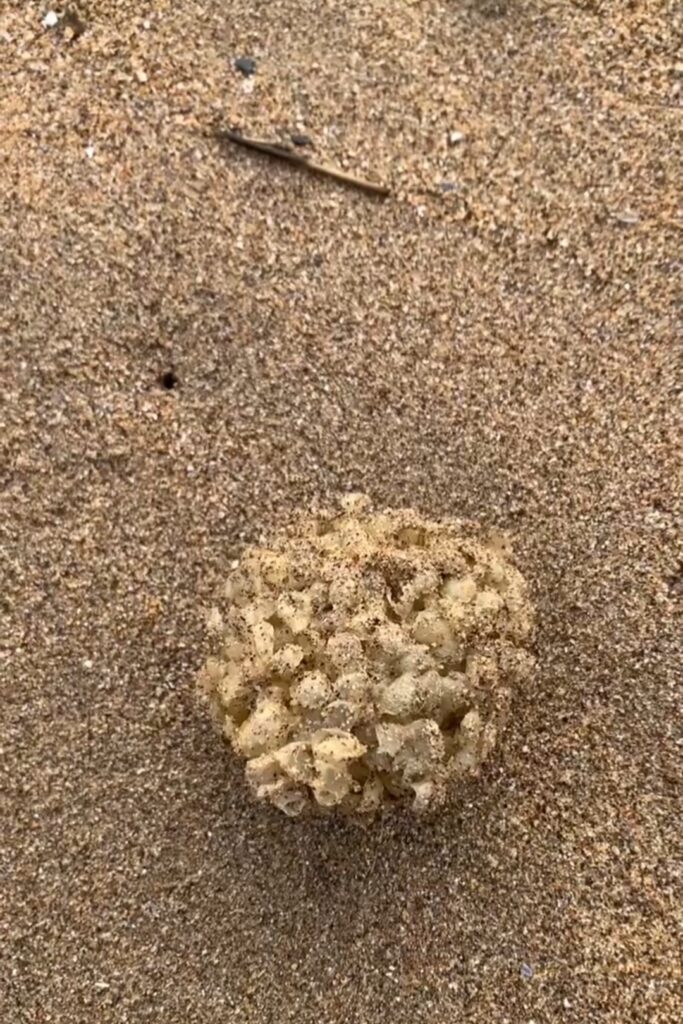
Common whelk egg case
Quick ID feature: Cloud like appearance
FUN FACT: Each “egg capsule” can contain hundreds of tiny whelk embryos, which hatch after several months as fully formed mini-whelks.
What is a Whelk?
A Whelk is a type of sea snail and is our largest sea snail in the UK. Some of our Whelk shells can grow up to 10cm long and their shells are often found on our strandline searches. It is carnivorous and eats mostly small crustaceans and mollusks.
Why do we find this on our strandline?
One Whelk can lay around 2000 eggs in this egg capsule! When the eggs hatch, what remains of the capsule tends to wash up on the strandline.

Cuttlefish bone
Quick ID feature: Bright white, hard and crusty.
FUN FACT: Cuttlefish bones are internal shells that help the animal control buoyancy which allows it to hover in the water.
What is a Cuttlefish?
Cuttlefish are a type of cephalopod, related to octopus and squid. Their skin can change colour to blend in to their surroundings, which is called camouflage. They have 8 arms with 2 tentacles and are a ferocious predator, hunting crabs and sometimes other cuttlefish!
Why do we find their bones on our strandline?
Cuttlefish live for roughly 2 years before they reproduce. After they reproduce, they die shortly afterwards. Because many Cuttlefish can reproduce at the same time and place, large numbers can die at the same time so thousands can wash up together. However, Cuttlefish bones are often the only part that gets washed up as their outer skin usually decomposes, leaving only the hard bone behind.

Common limpet shell
Quick ID feature: Circular white and brown bands around shell.
FUN FACT: Limpets have a strong muscular foot that acts like a suction cup, letting them cling tightly to rocks even in strong waves.
What is a Limpet?
A Limpet is a mollusk with a hard, conical shell that uses suction to stick onto shoreline rocks. They are sometimes exposed by the tide and they are herbivorous, meaning they eat vegetation like seaweed, plankton and algae.
Why do limpets wash up in the strandline?
Limpets, even with their muscular foot that suctions onto rocks, can sometimes be knocked off by large waves or rocks. When this happens, marine creatures like birds enjoy eating the Limpet’s soft inner body, leaving the empty shell behind.

Herring gull feather
Quick ID feature: Pale grey with tipped black and white stripe.
FUN FACT: Herring gull feathers are waterproof which keeps them dry and insulated while scavenging along the coast.
What is a Herring gull?
These are marine birds, often famed for stealing chips at the seaside. However, their true diet is made up of small fish, crustaceans and mollusks but these birds are very clever and highly opportunistic and often taking advantage of an unattended portion of chips.
Why do we find bird feathers in the strandline?
Birds have to renew their feathers each year and this is called molting. In some bird species, this can happen many times during the year. During the molt, dirds grow out their feathers and drop older ones as their feathers must be in peak condition to attract a mate, to fly strong and the protection of camouflage. Their summer plumage is bright to attract a mate and their winter plumage darker and more subtle, keeping them safer from predators.

Flat topshell
Quick ID feature: Flat top shape, shiny, vibrant spiralled pattern.
FUN FACT: Flat topshells graze on algae with their radula (a tiny toothed tongue), helping keep rock surfaces clean.
What is a topshell?
Topshells are a type of seasnail that eat vegetation like seaweed and algae. They live in rockpools and beyond low tide where they can graze on rocks. We sometimes see them on our Wildspace rock-pooling days in the summer.
Why do we find topshells on the strandline?
Sometimes, like Limpets, topshells get knocked off rocks by large waves that displace them. When this happens, their soft bodies are eaten by other marine creatures and we often find their shells washed up on the beach.

Bladderwrack
Quick ID feature: Small air-filled bladders usually found in pairs along the central rib, and smooth edges.
FUN FACT: The tiny bladders help the seaweed float, keeping it closer to sunlight for photosynthesis.
What is Bladderwrack?
Bladderwrack is a type of seaweed which is usually attached to the ocean floor and to rocks near and in rock pools. As Bladderwrack is a sea plant, it needs sun to photosynthesize and absorb nutrients.
Why do we find Bladderwrack seaweed in the strandline?
We find Bladderwrack sometimes when there’s been a large storm. When large waves crash in the ocean, this can displace and remove the Bladderwrack’s roots. Because this plant has air bladders to help it float when attached to the ocean floor, this can send it straight to the surface of the water and often washes up on our strandlines.

Spiny cockle shell
Quick ID feature: Heart-shaped with radiating ribs and small spines.
FUN FACT: The spines protect the cockle from predators and help it stay buried in sandy or muddy seabeds.
What is a Spiny Cockle?
Spiny cockles are a type of small clam; a mollusk that exists in shallow seafloor and in sandy burrows beyond low tide. It gets its name from the spiny sections on the top of the shell which keep it safe from predators and keep it anchored in the sand in burrows.
Why do we find Spiny Cockles in the strandline?
Spiny cockles bury themselves in sand to feed on small creatures circulating the waves. Their burrows are a couple inches beneath the surface of the sand and are just out of reach for most animals, but not all of them. For example, some shoreline waders have specialized beaks with extraordinary lengths to reach these cockles in their burrows. Once exposed, the birds eat the soft insides and leave the shells. These are then washed up by the sea.

*All species were either pictured on the beach or taken home to picture later, then returned to the same beach the following day.
What will you discover on YOUR strandline?
Head to your local beach and discover what you could find in the strandline. As you search, you’ll be able to recognize the clues and the evidence left behind by lots of different sea creatures. Each of the items we found above can tell us more about the animals that live in the waters beyond the shore.